
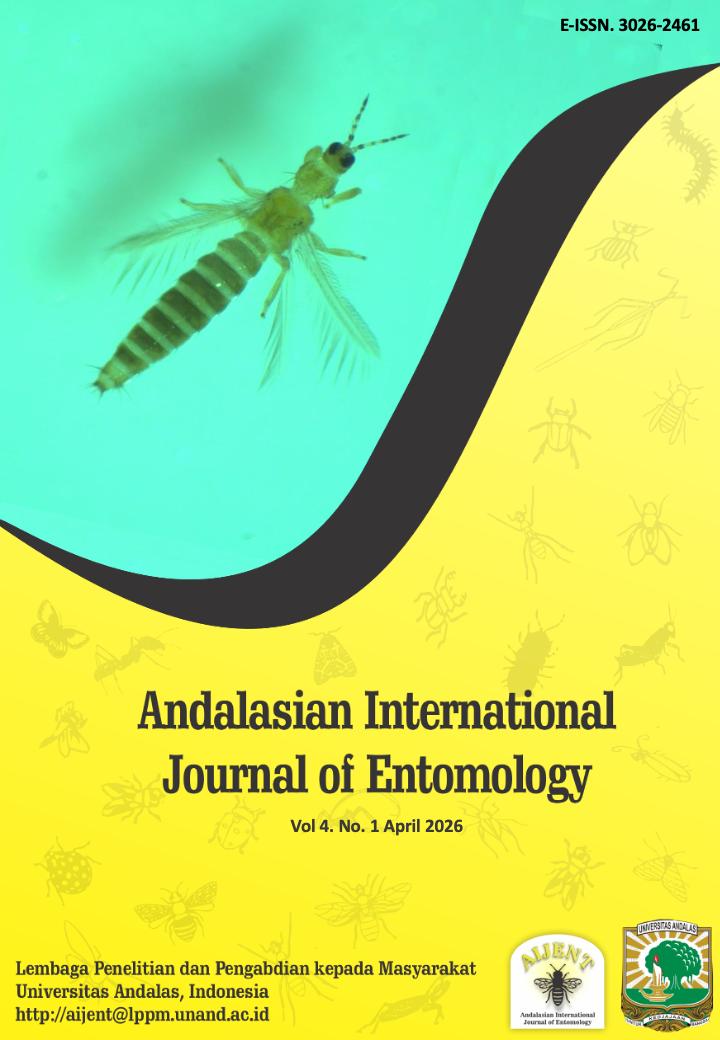
Seasonal Population Fluctuation and Sex Ratio of Frankliniella occidentalis on Greenhouses Melon in Arid Southeastern of Algeria, North Africa
DOI:
https://doi.org/10.25077/aijent.4.1.21-30.2026Keywords:
Arid conditions, Frankliniella occidentalis, greenhouse melon, population dynamics, sex ratioAbstract
The western flower thrips, Frankliniella occidentalis (Pergande 1895), is a polyphagous and invasive pest that causes serious damage to greenhouse crops. The present study aimed to examine the population changes, relative abundance, sex ratio, and species composition of thrips associated with melon (Cucumis melo L.) cultivated under greenhouse conditions in Garta, Algeria. Populations of F. occidentalis were monitored weekly from February to June 2017. Thrips densities increased with temperature; however, correlations with temperature (r = 0.54–0.55, p > 0.05) and relative humidity (r = 0.10–0.24, p > 0.05) were weak and not significant. Adults predominated on leaves, while larvae were less abundant (mean 7.44 per 30 leaves). High relative abundance was recorded across all sampling methods. Females largely predominated, accounting for 90.81–91.28% of adults, corresponding to a male-to-female ratio of approximately 1:9. Six thrips species were identified from the melon crop, with F. occidentalis being the dominant species. The other species included Odontothrips loti, Aeolothrips intermedius, Thrips minutissimus, Melanthrips fuscus, and Chirothrips manicatus, along with a few tubuliferous individuals. These results provide new insights into the population dynamics of F. occidentalis under arid greenhouse conditions and contribute to a better understanding of its prevalence in North African cropping systems.
Downloads
References
Ahmed, M.H., Ullah, M.I., Raza, A.B.M., Afzal, M., Khaliq, A., Iftikhar, Y., & Aatif, H.M. (2017). Population dynamics of Thrips tabaci (Lindeman) in relation to abiotic climate factors on Bt and non-Bt cotton cultivars. Journal of Zoology, 49(6), 1937–1943. https://doi.org/10.17582/journal.pjz/2017.49.6.1937.1943
Allache, F. (2021). Etude éco-biologique des thrips inféodés aux Cucurbitacées sous serre dans la région de Biskra. University of Biskra.
Aliakbarpour, H., Che Salmah, M.R., & Dieng, H. (2010) Species composition and population dynamics of thrips (Thysanoptera) in mango orchards of northern peninsular Malaysia. Environmental Entomology, 39(5), 1409–1419. https://doi.org/10.1603/EN10066
Baez, I., Reitz, S.R., Funderburk, J.E., & Olson, S.M. (2011). Variation within and between Frankliniella thrips species in host plant utilization. Journal of Insect Science, 11(1), 41. https://doi.org/10.1673/031.011.0141
Belaam, I., & Boulahia-Kheder, S. (2012). Inventory of thrips species in citrus orchards and assessment of scarring fruits in two citrus-producing regions of Tunisia. Tunisian Journal of Plant Protection, 7, 1–9
Benmessaoud-Boukhalfa, H., Mouhouche, F., & Belmazouzi, F. Z. (2010). Inventory and identification of some thrips species in coastal and sub-coastal regions of Algeria. Agriculture and Biology Journal of North America, 1(5), 755–761. DOI: 10.5251/abjna.2010.1.5.755.761
Chellemi, D.O., Funderburk, J.E., & Hall, D.W. (1994). Seasonal abundance of flower-inhabiting Frankliniella species (Thysanoptera: Thripidae) on wild plant species. Environmental Entomology, 23(2), 337–342. https://doi.org/10.1093/ee/23.2.337
Dantas, A.A.C., Holanda, I.S.A., Esteras, C., De Sousa Nunes, G.H., & Pico, M.B. (2015). Diversity of melon accessions from northeastern Brazil and their relationships with germplasms of diverse origins Journal of the American Society for Horticultural Science, 140(5), 504–517. https://doi.org/10.21273/JASHS.140.5.504
Deligeorgidis, P.N., Ipsilandis, C.G., Fotiadou, C., Kaltsoudas, G., Giakalis, L., & Garsen, A. (2005). Fluctuation and distribution of Frankliniella occidentalis (Pergande) and Thrips tabaci Lindeman (Thysanoptera: Thripidae) populations in greenhouse cucumber and tomato 8(8):1105-1111. Pakistan Journal of Biological Sciences, 8(8), 1105–1111. https://doi.org/10.3923/pjbs.2005.1105.1111
Ding, T., Chi, H., Gokçe, A., Gao, Y., & Zhang, B. (2018). Demographic analysis of arrhenotokous parthenogenesis and bisexual reproduction of Frankliniella occidentalis (Pergande) (Thysanoptera: Thripidae). Scientific Reports, 8, 334. https://doi.org/10.1038/s41598-018-21689-z
Elimem, M., & Chermiti, B. (2009). Population dynamics of Frankliniella occidentalis Pergande (1895) (Thysanoptera: Thripidae) and evaluation of its different ecotypes and their evolution in a rose (Rosa hybrida) greenhouse in the Sahline region, Tunisia. African Journal of Plant Science and Biotechnology, 3(1), 53 62.
Elimem, M., Harbi, A., & Chermiti, B. (2011).Populations of Frankliniella occidentalis Pergande (Thysanoptera: Thripidae) in a greenhouse pepper crop in the region of Moknine (Tunisia) in relation to environ mental conditions. African Journal of Plant Science and Biotechnology, 5(1), 30–34.
Frantz, G., & Mellinger, H.C. (2009). Shifts in western flower thrips, Frankliniella occidentalis (Thysanoptera: Thripidae), population abundance and crop damage. Florida Entomologist, 92(1), 29–34. https://doi.org/10.1653/024.092.0106
Garrick, T.A., Liburd, O.E., & Funderburk, J. (2016). Effect of humidity on fecundity and egg incubation of Frankliniella bispinosa and Frankliniella occidentalis (Thysanoptera: Thripidae). Florida Entomologist, 99(3), 505–508. https://doi.org/10.1653/024.099.0324
Ghosh, A., Dey, D., Timmanna, Basavaraj, Mandal, B., & Jain, R.K. (2017) Thrips as the vectors of tospoviruses in Indian agriculture. Mandal B., Rao G., Baranwal V. & R. Jain (Eds.) A Century of Plant Virology in India (hlm. 537–561). Springer.
Goldbach, R., & Peters, D. (1994). Possible causes of the emergence of tospovirus diseases. Seminars in Virology 5(2), 113-120. https://doi.org/10.1006/smvy.1994.1012
Gonzalez-Zamora, J.E., & Garcia-Mari, F. (2003). The efficiency of several sampling methods for Frankliniella occidentalis (Thysan., Thripidae) in strawberry flowers. Journal of Applied Entomology, 127, 516–521. https://doi.org/10.1046/j.0931-2048.2003.00783.x
Hansen, E.A. Funderburk, J.E., Reitz S.R., Ramachandran,S., Eger, J.E.& Mcauslane, H. (2003). Within-plant distribution of Frankliniella species (Thysanoptera: Thripidae) and Orius insidiosus (Heteroptera: Anthocoridae) in field pepper. Environmental Entomology, 32(4), 766–772.
Hazir, A., & Ulusoy, M.R. (2012). Population fluctuation of thrips species (Thysanoptera : Thripidae) in nectarine orchards and damage levels in Mediterranean region of Turkey east. Journal of the Entomological Research Society, 14(1), 41–52.
Higgins, C.J. (1992). Western flower thrips (Thysanoptera: Thripidae) in greenhouses: population dynamics, distribution on plants and associations with predators. Journal of Economic Entomology, 85(5), 1891–1903. https://doi.org/10.1093/jee/85.5.1891
Kasina, M., Nderitu, J., Nyamasyo, G., Waturu, C.,Olubayo, F., & Obudho, E. (2009). Within-plant distribution and seasonal population dynamics of flower thrips (Thysanoptera: Thripidae) infesting French beans (Phaseolus vulgaris L.) in Kenya. Spanish Journal of Agricultural Research, 29(2), 82–90. https://doi.org/10.5424/sjar/2009073-450
Kendall, D.M. &Capinera, J.L. (1990). Geographic and temporal variation in the sex-ratio of onion thrips. Southwestern Entomologist, 15, 80–88.
Kirk, W.D.J. (2002). The pest and vector from the West: Frankliniella occidentalis. Thrips and Tospoviruses: Proceedings of the 7th International Symposium on Thysanoptera, 2, 33-42.
Kirk, W.D.J., & Terry, L.I. (2003). The spread of the western flower thrips Frankliniella occidentalis (Pergande). Agriculture and Forest Entomology, 5(4), 301–310. https://doi.org/10.1046/j.1461-9563.2003.00192.x
Laamari, M., & Houamel, S. (2015). Première observation de Thrips tabaci et de Frankliniella occidentalis sur les cultures sous serre en Algérie. EPPO Bulletin 45(2), 205-206. https://doi.org/10.1111/epp.12202
Macintyre-Allen, J.K., Scott-Dupree, C.D., Tolman, J.H., & Harris, C.R. (2005). Evaluation of sampling methodology for determining the population dynamics of onion thrips (Thysanoptera: Thripidae) in Ontario onion fields. Journal of Economic Entomology, 96(6), 2272–2281. https://doi.org/10.1603/0022-0493-98.6.2272
Mailhot, D., Maroi, J., & Wright, D. (2007). Species of thrips associated with cotton flowers. Journal of Cotton Science, 11, 186–198.
Marullo, R., & De Grazia, A.(2012). Notes on sex ratio and reproductive modes in field populations of two pest thrips species (Thysanoptera, Thripidae) in Italy. Acta Phytopathologica et Entomologica Hungarica, 47(1), 117–123. https://doi.org/10.1556/APhyt.47.2012.1.15
Mcdonald, J.R., Bale, J., &, Walters, K.F.A. (1998). Effect of temperature on development of the western flower thrips, Frankliniella occidentalis (Thysanoptera: Thripidae). European Journal of Entomology, 95(2), 301–306.
Miliczky, E., & Horton, D.R. (2011). Occurrence of the western flower thrips, Frankliniella occidentalis, and potential predators on host plants in near orchard habitats of Washington and Oregon (Thysanoptera: Thripidae). Journal of the Entomological Society of British Columbia, 108, 11–28.
Mound, L.A., & Teulon, D.A.J. (1995). Thysanoptera as phytophagous opportunists. In BL Parker, M Skinner &T Lewis (Eds.) Thrips Biology and Management, (pp. 3-19), New York, Plenum Publishing Corp.
Nyasani, J.O., Meyhofer, R., Subramanian, S., & Poehling, H.M. (2013). Seasonal abundance of western flower thrips and its natural enemies in different French bean agroecosystems in Kenya 86:515-523. Journal of Pest Science, 86, 515–523. https://doi.org/10.1007/s10340-013-0491-0
Ozsemerci, F., Aksit, T., &Tunç, I. (2011). Composition, seasonal abundance and within- plant distribution of Thysanoptera species associated with seedless grapes (Sultana) in districts of Manisa, Turkish Journal of Entomology, 35(1), 103–118.
Paini, D.R., Funderburk, J.E., & Reitz, S.R. (2008). Competitive exclusion of a worldwide invasive pest by a native. Quantifying competition between two phytophagous insects on two host plant species. Journal of Animal Ecology, 77(1), 184–190. https://doi.org/10.1111/j.1365-2656.2007.01324.x
Palomo, L.A.T., Martinez, N.B., Johansen-Naime, R., Napoles, J.R., Leon, O.S., Arroyo, H.S.,& Graziano, J.V.( 2015). Population fluctuations of thri.ps (Thysanoptera) and their relationship to the phenology of vegetable crops in the central region of Mexico. Florida Entomologist, 98(2), 430–438. https://doi.org/10.1653/024.098.0206
Pickett, C.H., Wilson, L.T., & Gonzalezi, D. (1988). Population dynamics and within-plant distribution of the western flower thrips (Thysanoptera: Thripidae), an early-season predator of spider mites infesting cotton. Environmental Entomology, 17, 551–559.
Pizzol, J., Nammour, D., Hervouet, P., Bout, A., Desneux, N., & Mailleret, L.(2010). Comparison of two methods of monitoring thrips populations in a greenhouse rose crop. Journal of Pest Science, 83(2), 191–196. https://doi.org/10.1007/s10340-010-0286-5
Pizzol, J., Nammour, D., Rabasse, J.M., Parolin, P., Desneux, N., Poncet, C., & Reynaud, P. (2014). Species and population dynamics of thrips occurring inside and outside greenhouses cultivated with roses in southern France. International Journal of Agricultural Policy and Research, 2, 141–153.
Puche, H., Berger, R.D., & Funderburk, J.E. (1995). Population dynamics of Frankliniella species (Thysanoptera : Thripidae) thrips and progress of spotted wilt in tomato fields. Crop Protection, 14(7), 570–583. https://doi.org/10.1016/0261-2194(95)00000-3
Ramachandran, S., Funderburk, J., Stavisky, J., &Olson, S. (2002). Population abundance and movement of Frankliniella species and Orius insidiosus in field pepper. Agricultural and Forest Entomology, 3(2), 129–137. https://doi.org/10.1046/j.1461-9563.2001.00097.x
Razi,S., Bernard, E.C., & Laamari, M. (2017). A survey of thrips and their potential for transmission of viruses to crops in Biskra (Algeria): First record of the species Frankliniella intonsa and Thrips flavus. Tunisian Journal of Plant Protection, 12(2): 197–205.
Razi,S., Laamari, M., Ouamen, S., & Bernard, E.C. (2013). Thysanoptera survey on Vicia faba broad bean in the arid Biskra region of Algeria. Agricultural and Biological Journal of North America, 4(3), 268–274.
Reitz, S.R. (2002). Seasonal and within plant distribution of Frankliniella thrips (Thysanoptera:Thripidae) in North Florida tomatoes. Florida Entomologist, 85(3), 431–439.
Reitz, S.R. (2009). Biology and ecology of the western flower thrips (Thysanoptera : Thripidae): the making of a pest. Florida Entomologist, 92(1), 7–13. https://doi.org/10.1653/024.092.0102
Ripa, R., Funderburk,J., Rodriguez, F., Espinoza, F., & Mound, L. (2009). Population abundance of Frankliniella occidentalis (Thysanoptera: Thripidae) and natural enemies on plant hosts in central Chile. Environmental Entomology, 38(2), 333–344. https://doi.org/10.1603/022.038.0205
Roditakis, Ν.E. (1991). First record of Frankliniella occidentalis in Greece. Entomologia Hellenica, 9, 77–79. https://doi.org/10.12681/eh.13995
Rosenheim, J.A., Welter, S.C., Johnson, M.W., Mau, R.F.L., & Gusukuma-Minutoi, L.R.(1990). Direct feeding damage on cucumber by mixed-species infestations of Thrips palmi and Frankliniella occidentalis (Thysanoptera: Thripidae). Journal of Economic Entomology, 83(4), 1519–1525. https://doi.org/10.1093/jee/83.4.1519
Roth, F., Galli, Z., Toth, M., Fail, J., & Jenser, G. (2016). The hypothesized visual system of Thrips tabaci Lindeman and Frankliniella occidentalis (Pergande) based on different coloured traps’ catches. North-Western Journal of Zoology, 12(1), 40–49.
Sevik, M.A.,& Arli-Sokmen, M. (2012). Estimation of the effect of Tomato spotted wilt virus (TSWV) infection on some yield components of tomato. Phytoparasitica, 40,87-93. https://doi.org/10.1007/s12600-011-0192-2
Tao, M., Wan, Y., Zheng, X., Qian, K., & Merchant, A., Xu, B.,Zhang, Y.,Zhou, X.,& Wu, Q. (2022). Tomato spotted wilt orthotospovirus shifts sex ratio toward males in the western flower thrips, Frankliniella occidentalis, by down-regulating a FSCB-like gene. Pest Management Science, 78(11), 5014–5023. https://doi.org/10.1002/ps.7125
Waiganjo, M.M., Gitonga, L.M., &Mueke, J.M. (2008). Effects of weather on thrips population dynamics and its implications on the thrips pest management. African Journal of Horticultural Science, 1(1), 82–90.
Wang, J.C., Zhang, B., Li, H.G.,Wang, J.P., & Zheng, C.Y. (2014) Effects of exposure to high temperature on Frankliniella occidentalis (Thysanoptera: Thripidae), under arrhenotoky and sexual reproduction conditions. Florida Entomologist, 97(2), 504–510. https://doi.org/10.1653/024.097.0222
Welter, S.C., Rosenheim, J.A., Johnson, M.W., Mau, R.F.L., & Gusukuma-Minuto, L.R. (1990) Effects of Thrips palmi and western flower thrips (Thysanoptera: Thripidae) on the yield, growth, and carbon allocation pattern in cucumbers. Journal of Economic Entomology, 83(5), 2092–2101.
Zhang, Z., Zhang, J., Li, X., Zhang, J., Wang, Y., & Lu,Y. (2023). The Plant Virus Tomato Spotted Wilt Orthotospovirus Benefits Its Vector Frankliniella occidentalis by Decreasing Plant Toxic Alkaloids in Host Plant. International Journal of Molecular Sciences, 24(19), 14493. https://doi.org/10.3390/ijms241914493
Downloads
Published
How to Cite
Issue
Section
License
Copyright (c) 2026 Farid Allache, Fatma Demnati, Sabah Razi

This work is licensed under a Creative Commons Attribution-ShareAlike 4.0 International License.